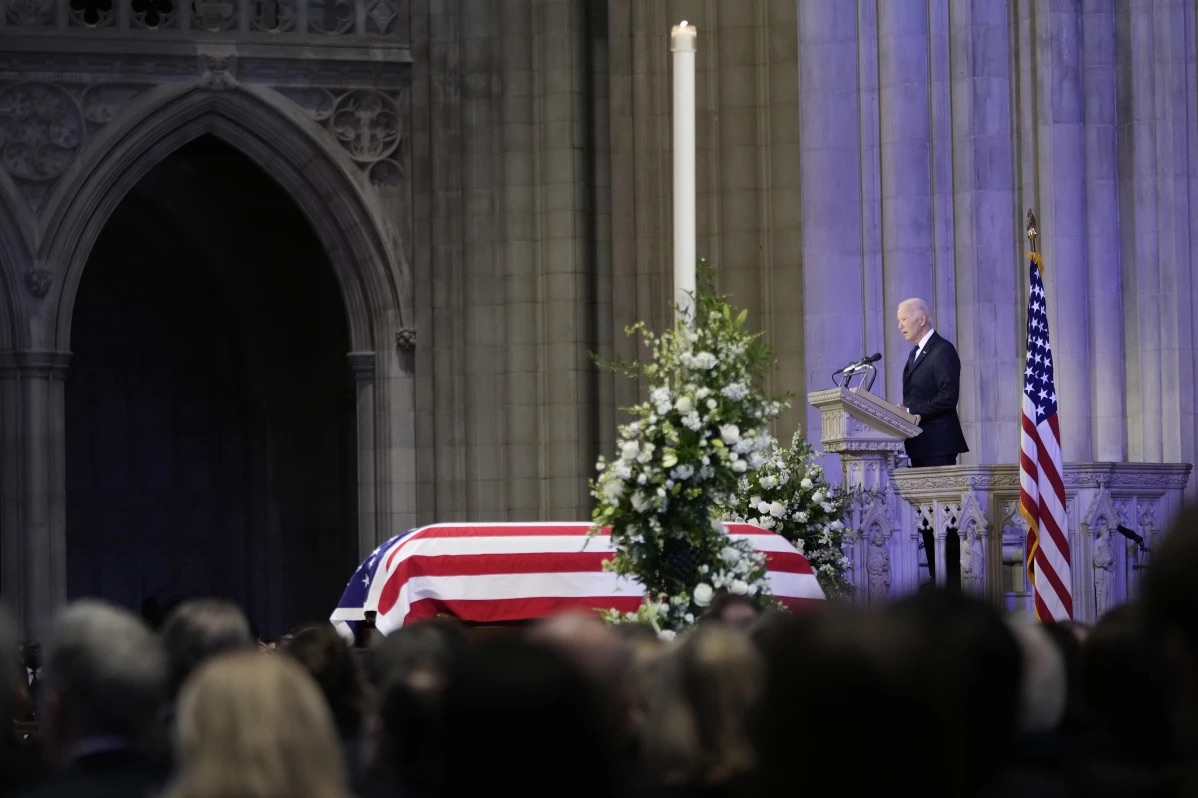
One year ago today, my grandfather Jimmy Carter passed away.
We all knew it was coming. My grandfather had been in hospice for 22 months, and we had celebrated his 100th birthday. It was his time, and he knew it. And he even welcomed it. That didn’t make it any easier.
I have lost my brother, my mom, and now both of my grandparents, and every time someone you love dies, it creates this bright demarcation line in your life. There is a before, and there is an after. It does not matter how long they lived, how full their life was, or how much time you had to prepare. The finality of it is still profound.
When Papa died, our family had only a few minutes to ourselves before the news spread around the world. About ten minutes after I got the call, the first condolence text arrived from a friend. Then another. Then the trickle became a flood, and the flood became a tsunami. Suddenly, my grandfather was everywhere.
I grew up after the presidency. I missed the campaign, Camp David, the Panama Canal treaties, and normalizing relations with China. During my lifetime, Papa regularly made international news, but usually for a moment. His death was something entirely different.
The next morning, exhausted and numb, I was lying on my couch in pajama pants, scrolling through messages when I came across a statement from King Charles mourning my grandfather. I remember staring at the signature, “Charles R.,” and getting distracted thinking about the R—for Rex, for King—and how strange it looked after a lifetime of seeing Queen Elizabeth sign “Elizabeth R.” And then it hit me that the King of England had just written my family a sympathy card and posted it on Facebook.
The entire world was remembering my grandfather.
What struck me most was what people remembered him for. They remembered peace. Human rights. Democracy. Global health. His commitment to easing human suffering. His humility. His character.
I have spent the past year thinking about those things.
I have traveled around the country talking about my grandparents’ work on caregiving, peace, conservation, submarines, public service, mental health, and democracy. I traveled to Liberia to help transition a mental health program my grandparents helped build over to the Liberian government. I spoke at the dedication of the Jimmy and Rosalynn Carter School of Public Policy at Georgia Tech. I celebrated a new Jimmy Carter postage stamp on what would have been his 101st birthday.
For a year, I have seen my grandfather from almost every angle, but my mind keeps returning to Christmas in Plains.
As a child, I worried that the Secret Service might not let Santa onto the property. My dad assured me that Santa knew to stop at the Command Post first. I thought about my brothers and cousins rushing into my grandparents’ living room at about 6:00 in the morning to find our presents. I thought about Mary’s homemade biscuits and my grandfather Papa putting cane syrup on his pancakes. I thought about how I never understood how anyone could drink buttermilk on purpose.
And I thought about my grandfather’s favorite turkey hunting story. I thought about the time my dad walked into my grandfather’s office and interrupted his conversation with Hillary Clinton about North Korea, asking Papa if he wanted a glass of wine. He said yes. It was Christmas Eve, after all.
In this episode, I look at the work that consumed most of his life after the presidency: the work of The Carter Center to Wage Peace, Fight Disease, and Build Hope.
My grandfather was someone who could tell Charles Taylor to cease fire in his civil war in Liberia, so he could land his plane and talk peace. He was a man who could move entire governments to eradicate biblical plagues just by threatening to rename an awful worm. He was a man who traveled to North Korea multiple times for peace. And once more, just because he was the only person in the world who could bring an American home.
His entire life was one of service: to his country as a naval officer, to Georgia as a state senator and governor, to the United States as President, and then to humanity as a peacemaker, disease fighter, election monitor, home builder, and advocate for human rights.
My grandfather taught me about elections and democracy—not as abstract political ideas, but as tools ordinary people can use to protect themselves from oppression and hold their leaders accountable.
And at the same time, he taught me how to read a trout stream, tie a fly, cut a dovetail, call a turkey, put shingles on a Habitat house, and negotiate in an African street market.
His biggest lessons were that peace is hard, worthy goals require patience, and that everywhere in the world—in every country, every culture, every community, and at every economic level—there are people every bit as intelligent, loving, hopeful, committed to their families, and invested in a better future as we are.
I love you, Papa.